
In brief: Charging your electric vehicle with solar panels typically requires between 7 and 10 solar modules rated at 400 Wp to cover an average daily journey of 50 km in the Var region.
The total cost of a solar installation combined with an EV charging station generally ranges from €6,000 to €15,000, with an estimated payback period of 7 to 10 years.
In 2026, the self-consumption bonus reaches €80/kWp (up to €720 for a 9 kWp system), and VAT is reduced to 5.5% for installations of 9 kWp or less.
Edmond Solutions, a certified RGE installer operating in the Var and Alpes-Maritimes, delivers these projects as a turnkey solution.
The integration of solar panels into an electric vehicle charging system is attracting increasing interest each year from homeowners, businesses, and public organizations looking to better control their energy costs while reducing their environmental impact.
A well-designed photovoltaic installation not only helps improve energy independence, but also enables significant long-term savings.
This guide explains how solar EV charging works, breaks down the associated costs, compares the available solutions, and provides sizing guidance to help you find the right balance between solar production and EV charging needs.
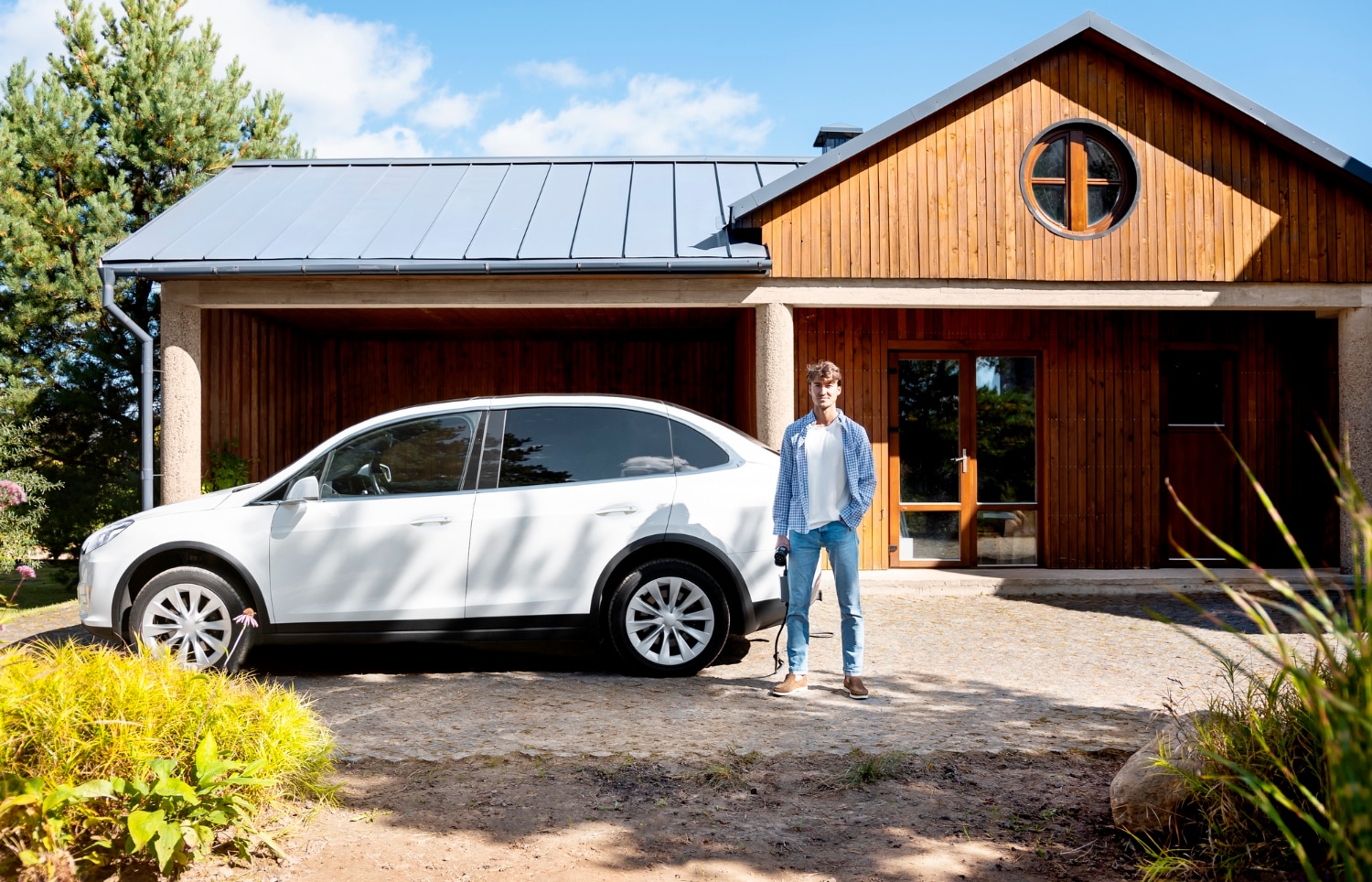
Understanding how solar EV charging works
Charging your electric vehicle directly with the energy produced by solar panels is based on a simple principle: the direct current (DC) generated by the photovoltaic cells is converted into alternating current (AC) and then sent to an EV charging station connected to the vehicle.
This setup promotes self-consumption and reduces dependence on the traditional electricity grid.
To optimize the system, several factors need to be considered:
- the amount of solar energy available during the day
- the power output of the photovoltaic system
and the charging - capabilities of the vehicle itself
The better the solar panel efficiency, orientation, and overall system design, the greater the amount of clean electricity available for charging.
The goal is therefore to match the number of solar modules and the installed capacity to your daily driving needs.
Edmond Solutions, a certified RGE QualiPV installer operating in the Var (83) and Alpes-Maritimes (06), provides this personalized sizing study free of charge.
What are the advantages and disadvantages of this approach?
Economic and environmental benefits
Choosing solar charging for your electric vehicle offers several significant advantages.
First and foremost, using the electricity generated directly by your solar panels helps reduce the energy costs associated with daily mobility. Over time, this approach supports the payback of the initial investment through the savings made compared with standard home charging or public charging stations.
Adding a photovoltaic installation to your property also contributes actively to the local and national energy transition.
It helps reduce your carbon footprint, lowers your exposure to fluctuations in electricity prices, and can even increase the value of your home.
Producing and consuming your own electricity also strengthens your energy security, making you less dependent on changes in the energy market.
Technical constraints and seasonal limitations
Despite its many advantages, solar EV charging also comes with a few limitations.
First, a rooftop installation with limited solar exposure will not always be able to provide a full vehicle charge.
System performance can vary significantly depending on the season, the orientation and tilt of the solar panels, and overall weather conditions—all of which directly affect the amount of energy actually produced.
Par ailleurs, le coût d’acquisition et de pose d’une borne de recharge IRVE ou bidirectionnelle s’ajoute à celui des panneaux. Il demeure essentiel de bien étudier son profil d’utilisation — kilomètres parcourus, horaires de recharge souhaités — pour choisir le dimensionnement le mieux adapté.
Sizing your photovoltaic system correctly for EV charging
What factors does the sizing calculation depend on?
Sizing a solar installation for EV charging depends on several key factors: the type of electric vehicle, its battery capacity, the average energy consumption per kilometer, and the number of weekly trips.
A preliminary assessment makes it possible to determine the optimal installed capacity (kWp) and estimate the required roof surface area.
Edmond Solutions provides this analysis free of charge for homeowners and businesses in the Var and Alpes-Maritimes.
How many solar panels do you need depending on your vehicle?
Let’s take the example of an electric car that consumes an average of 15 kWh/100 km and is driven 50 km per day. That represents a daily energy requirement of 7.5 kWh.
Assuming a 400 Wp solar panel produces around 1 kWh per day under the sunshine conditions of the Var region (with over 2,700 hours of sunshine per year in the Dracénie area), you would need at least 8 solar panels to cover the full charging requirement—excluding household electricity consumption.
This estimate remains indicative and may vary depending on:
- the solar panel technology
- the tilt angle
- the geographic location
- and whether a battery storage system is used to shift charging outside daylight hours
Costs and profitability of solar EV charging
What does this type of installation cost?
Investing in a photovoltaic installation combined with an EV charging station requires a higher upfront budget than a simple dedicated charging outlet.
However, this solution allows you to benefit from financial incentives while significantly reducing the total cost of ownership of your vehicle over the years.
Component | Estimated cost (€) |
|---|---|
Solar panels (4 to 12 kWp) | 5 000 – 11 000 |
Smart EV charging station | 1 200 – 2 500 |
Battery storage (optional) | 3 000 – 7 000 |
Installation | 1 000 – 3 000 |

Comparison with standard EV charging
Charging your electric vehicle with solar panels helps you avoid the regular increases in electricity prices.
In 2026, it also gives access to financial incentives, including:
- Reduced 5.5% VAT for installations up to 9 kWp in self-consumption
- A self-consumption bonus of €80/kWp (up to €720 for a 9 kWp system), paid one year after commissioning
Over time, a photovoltaic installation typically becomes profitable within 7 to 10 years, thanks to the savings generated.
However, solar EV charging does require a higher initial investment and more careful planning to ensure compatibility with your charging station and daily usage.
Questions to ask before installing a solar EV charging solution
There are several key questions that determine whether a solar charging project is right for your needs.
You should take into account:
- your EV battery capacity
- the solar potential of your roof
- and how frequently the vehicle is used
A precise assessment helps ensure the right energy mix between solar production, household consumption, and vehicle charging.
Beyond long-term system performance, it is also important to review the available incentives in 2026, including:
- the self-consumption bonus (€80/kWp, up to €720)
- reduced 5.5% VAT
- and possible local subsidies from the Région Sud or Toulon Provence Méditerranée metropolitan authority
Edmond Solutions supports you throughout the entire process—from the free feasibility study to final commissioning.
Request your free solar + EV charging quote today.
Frequently asked questions about solar EV charging
How many solar panels are needed to charge an electric car?
The number of solar panels required depends on your electric vehicle’s battery capacity, your daily driving habits, and the local solar production conditions.
To cover an average daily distance of 50 km, you will typically need around 7 to 10 solar panels rated at 400 Wp for near-complete charging in the Var region.
Example
- For 300 km per week: approximately 8 panels of 400 Wp
Important
- If your system is used for both household consumption and EV charging, it is recommended to plan for additional capacity
Are there any incentives available to help fund a photovoltaic system dedicated to EV charging?
Yes, several financial incentives are available in France in 2026 to support the installation of solar panels:
Available incentives
- Self-consumption bonus: €80/kWp (up to €720 for a 9 kWp system) — 2026 feed-in tariff rate
- Reduced 5.5% VAT for installations of 9 kWp or less in self-consumption (effective since January 1, 2026)
- Local and regional grants, particularly from municipalities and the Région Sud
Is optimizing photovoltaic production enough to make EV charging fully self-sufficient?
Maximizing self-consumption with a system sized according to your actual usage can bring you much closer to real charging autonomy.
However, to maintain reliable charging when there is no sunlight, it is still recommended to use battery storage and smart charging scheduling.
Best practices
- Schedule charging during peak solar production hours
- Maintain your solar panels regularly
- Add battery storage if greater energy independence is required
Can solar charging damage your vehicle’s battery?
No. When solar charging is carried out through a compliant EV charging station and a certified solar installation, it does not damage the vehicle’s battery.
Modern systems are designed to provide a stable and controlled power supply, in line with the manufacturer’s recommended charging cycles.
Why it is safe
- Continuous monitoring of voltage and current
- Safe and reliable connected charging interfaces