
In 2025, 70% of new vehicle sales involved an electrified vehicle. As of 1 January 2026, 1.4 million fully electric cars were on the road. These latest ANFA figures confirm that electric mobility is gradually becoming part of everyday life in France. The question is no longer simply where to charge a vehicle, but how to do so efficiently, safely and at the lowest possible cost.
At home, in a condominium, at a business or in a publicly accessible car park, installing an EV charging station is not simply a matter of adding electrical equipment. The solution must be suited to the vehicle or vehicles, travel habits, available power and installation location. When photovoltaic panels are already installed, or included in the project, the charging station becomes even more valuable. If selected and managed correctly, it can use part of the solar surplus to charge an electric car rather than injecting that energy into the grid.
In this new practical guide, the Edmond Solutions team helps you make the right choices: charging station or reinforced socket, the questions to ask before choosing, solutions for different user profiles, solar charging, available support and the legal obligations to comply with.
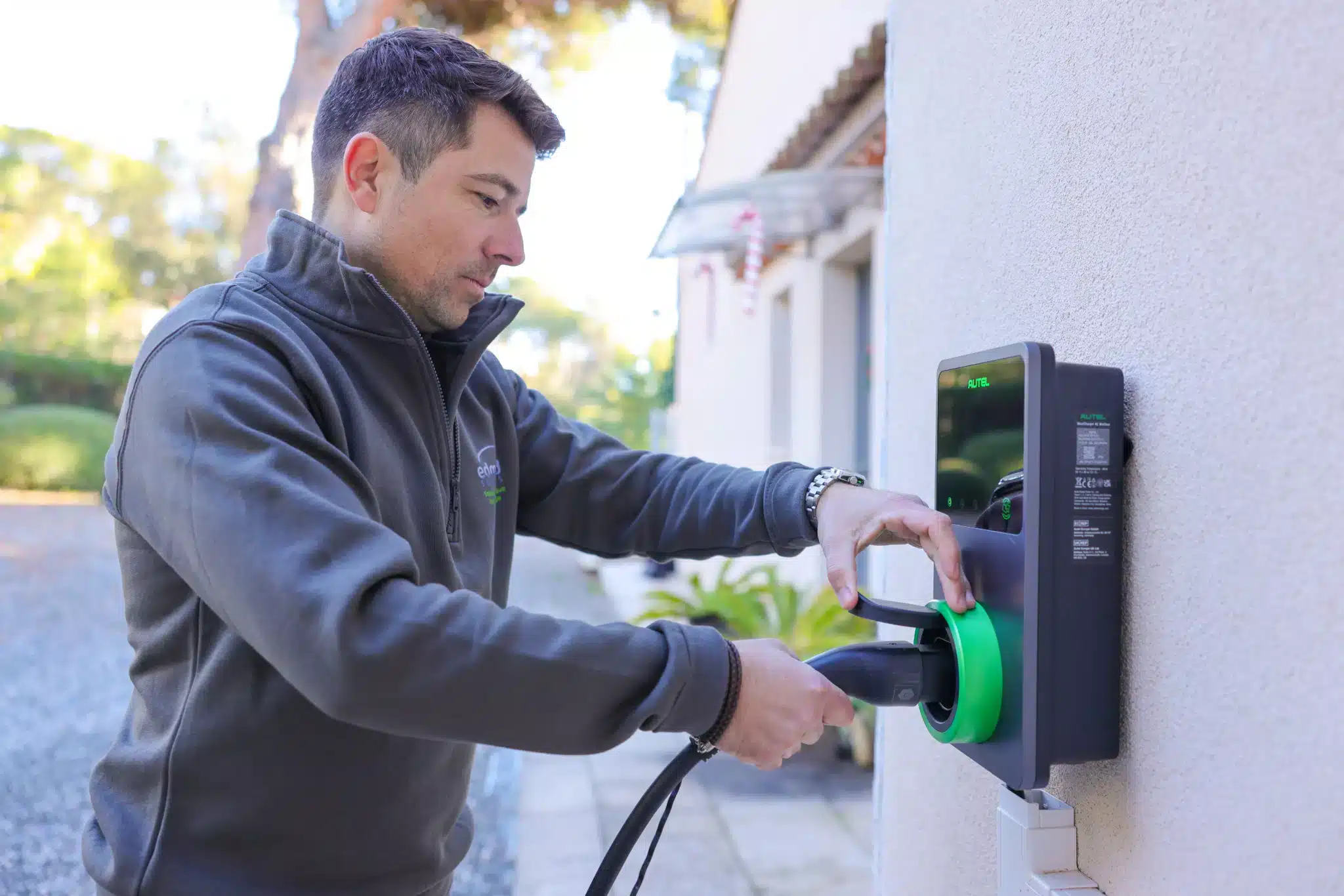
EV charging station or reinforced socket: which solution should you choose at home?
Let us begin with the first question asked by future electric vehicle drivers: should you install a “proper” EV charging station, or is a reinforced socket sufficient? You will notice that a standard domestic socket is not one of the options. There is a good reason for this: it is not designed to withstand long and repeated charging sessions. It should therefore remain an occasional back-up solution only.
A reinforced socket looks like a standard domestic socket, but it is specifically designed and protected for vehicle charging. With a power rating of around 3.2 kW, it can provide approximately 50 kilometres of range in about three hours. It is the most economical solution to purchase and is suitable for low-mileage drivers and plug-in hybrid vehicles, whose smaller batteries are well suited to slower charging.
An EV charging station, or wallbox, is a step up. With a power rating ranging from 7.4 to 22 kW, it significantly reduces charging times. A 7.4 kW charging station can, for example, provide around 100 kilometres of range in approximately three hours, twice as much as a reinforced socket. Above all, a charging station provides access to smart-charging features: scheduling charging sessions according to your needs, prioritising off-peak hours, monitoring consumption and, as we will explain later, synchronising charging with your solar production.
Good to know: taxation can also make a difference. In 2026, the installation of an EV charging station by an IRVE-qualified professional benefits from a reduced VAT rate of 5.5%, while the installation of a reinforced socket is subject to a 10% rate.
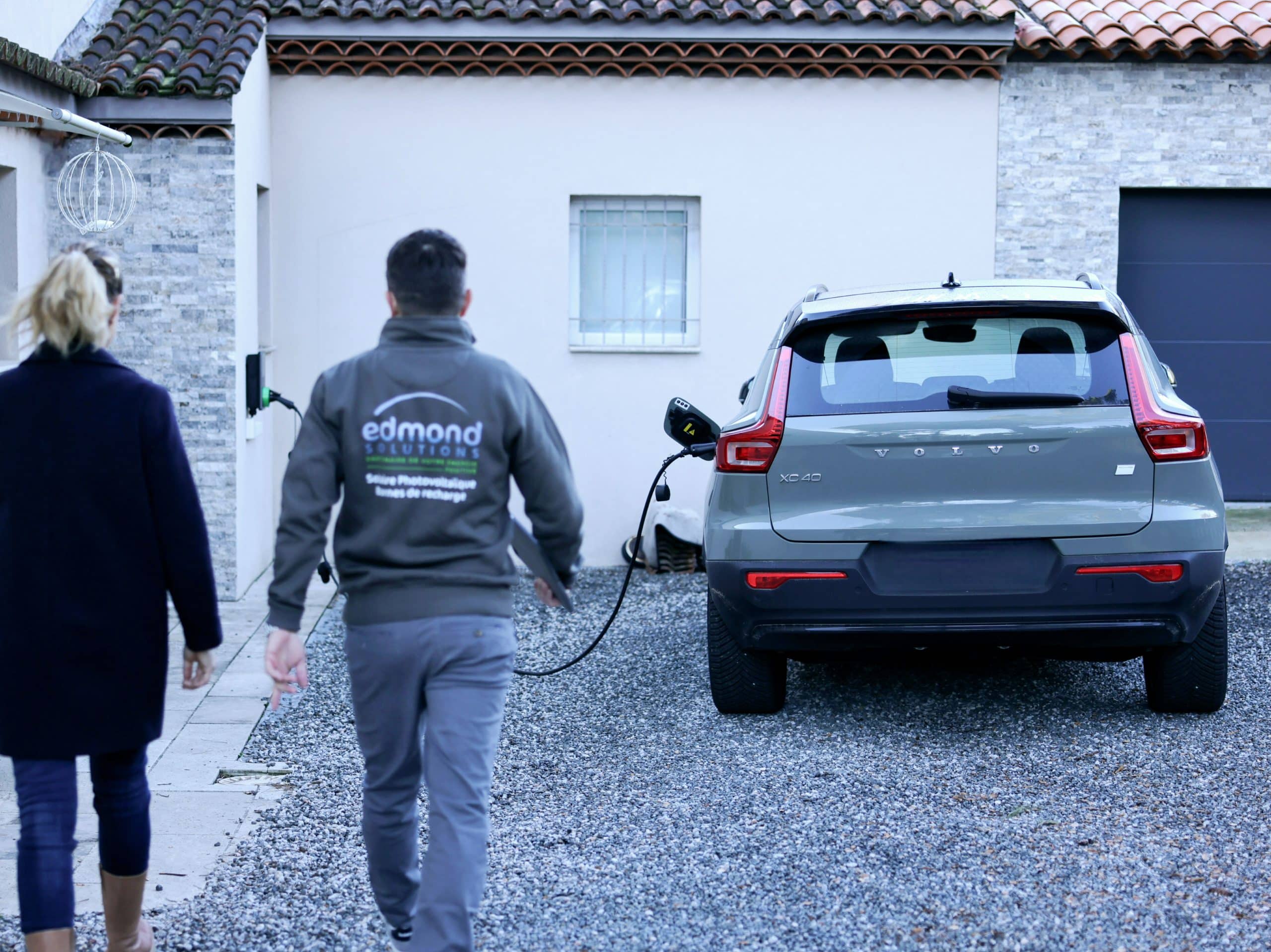
Questions to ask before choosing your EV charging station
Have you decided on a charging station?
Excellent choice! The next step is to define the right configuration. Here are the essential questions to ask yourself. To better understand the technical terms and specific acronyms, you can also consult our electric mobility glossary.
What vehicle do you have and, above all, what charging power can it accept?
Not all electric cars accept the same charging power. For alternating-current (AC) charging, the maximum is determined by the vehicle’s onboard charger. This information is generally provided in the vehicle’s technical specifications. There is therefore no point investing in a 22 kW charging station if your vehicle can accept no more than 7.4 kW: charging will take place at the speed supported by the onboard charger, not at the charging station’s maximum power. Conversely, an undersized charging station will unnecessarily extend charging times.
How many kilometres do you drive each day?
A driver who travels 40 kilometres a day does not have the same needs as a professional who covers 300 kilometres. In the first case, a few hours of charging may be sufficient. In the second, the charging station’s power becomes an important comfort factor.
What can your electrical installation support?
The power rating of your electricity meter, expressed in kVA, and the type of supply, single-phase or three-phase, determine the charging power that can be installed. A 7.4 kW charging station is generally compatible with a standard single-phase installation. For higher power ratings, such as 11 kW or 22 kW, a three-phase installation is usually required. Some charging stations also include dynamic power-management functions. They adapt charging to the power available in the property, reducing the risk of the electricity supply tripping and, in some cases, avoiding the need to increase the electricity subscription.
Where will the charging station be installed?
An enclosed garage, carport, exterior wall or shared car park: the location influences the choice of equipment, the required protection rating, the cable length and, ultimately, the installation cost.
When will the vehicle be parked and available for charging?
At night, during the day, at weekends or during working hours? This question is essential, especially when you want to use your solar energy production.
Homeowner, condominium, business… which charging solution suits your profile?
A detached house, condominium, business or publicly accessible car park: an IRVE charging station does not address the same challenges in every location. Number of users, available power, access to the charging station, supervision, billing and solar production are all factors, and each configuration has its own constraints.
Detached houses: simplicity above all
For a homeowner in a detached house, the main objective is often to charge the vehicle easily at home without relying on public charging stations. It is also the simplest configuration to implement: a technical visit, a quotation and then a generally quick installation when the property’s electrical system allows it. The charging station is connected to the electrical panel through a dedicated circuit with appropriate protective devices, in accordance with current safety requirements. This is also the ideal configuration for combining vehicle charging with a self-consumption photovoltaic installation.
Condominiums: the right to install a charging point or a shared infrastructure
Do you live in an apartment and have a parking space? Under the French “right to a charging point”, owners and tenants may have a charging point installed at their own expense. The condominium may object only on serious and legitimate grounds. In practice, the property manager must be informed and provided with a technical description of the project before work begins. This individual solution meets an immediate need.
However, when several residents want charging facilities, a shared infrastructure often becomes more appropriate. It allows some costs to be shared and makes future connections easier to organise. The ADVENIR programme may support certain projects in apartment buildings, depending on the type of installation and the applicable funding limits.
Good to know: the French LOM Act includes pre-equipment obligations for certain collective residential buildings, making it easier to install charging points at a later date. The rules vary according to the type of building, the number of parking spaces and the date of the building permit.
Businesses: a regulatory obligation and an opportunity
For businesses, charging is becoming an increasingly strategic issue. Since January 2025, the LOM Act has required charging points in the car parks of certain non-residential buildings. Beyond the regulatory framework, installing IRVE charging stations is also an excellent opportunity to support the electrification of a fleet, provide an additional service to employees and enhance the company’s image. The benefits are even greater for businesses equipped with photovoltaic panels. When vehicles are parked during the day, part of their charging can be supplied by solar electricity produced on site. The charging station then becomes an additional way to increase self-consumption and make better use of the electricity generated.
Publicly accessible car parks: a service that builds loyalty
Shops, hotels, restaurants, campsites, tourist attractions and local-authority car parks can all create added value by providing a charging solution. A publicly accessible charging station can attract customers with electric vehicles, extend the time they spend on site and highlight the organisation’s environmental commitment. These projects are more technical than residential installations. They may require several charging points, a payment system and sometimes more extensive maintenance. For some car parks, the project can also be combined with photovoltaic canopies. Existing car parks covering more than 1,500 m² are subject to a gradual requirement for photovoltaic canopies incorporating renewable-energy production systems. In this situation, it makes sense to consider the project as a whole: parking, solar production, electric charging, self-consumption and energy management.

Charging your car with solar surplus: the winning combination for 2026
Here we are. If you have read our special 2026 solar guide, you will know the new rules: with the feed-in tariff set at 1.1 euro cents per kilowatt-hour, injecting solar electricity into the grid now generates very little income. By contrast, every self-consumed kilowatt-hour avoids purchasing electricity from a supplier at a cost of approximately 19 to 20 euro cents.
An electric car consumes an average of 15 to 20 kWh per 100 kilometres. It is therefore one of the most energy-intensive appliances in a household, but also one of the most useful for absorbing excess solar production. The calculation is clear: rather than injecting a kilowatt-hour into the grid for very little compensation, it is better to use it to charge the vehicle. Depending on the electricity contract and feed-in conditions, a self-consumed kilowatt-hour can be valued approximately 15 to 18 times more than a kilowatt-hour sold to the grid. Compared with charging entirely from the grid, driving with solar surplus can therefore significantly reduce the running cost of an electric vehicle.
How does it work in practice? Everything depends on charging control. A smart charging station combined with an energy-management system can monitor the photovoltaic panels’ production and the property’s consumption in real time. When the panels produce more electricity than the home consumes, the available surplus is directed to the charging station. The charging power then adjusts automatically to the solar energy actually available. If production increases, the station can charge faster. If other equipment consumes more electricity, charging slows down. Some charging stations also offer several operating modes: 100% solar charging when the vehicle can remain connected for several hours, or mixed solar-and-grid charging when you need to recover range more quickly.
Do you need to add a battery? Not necessarily. If your vehicle is regularly parked at home during the day, it can already absorb a significant share of the solar surplus. In this case, the priority is often to choose a charging station that is compatible with photovoltaic energy management before considering a battery. However, if the car is away during production hours and returns only at the end of the day, the solar surplus is not available at the right time. Two solutions can then be considered: physical storage, which retains some of the electricity produced for later use, or a virtual battery, which provides another way to value the energy injected into the grid according to the terms of the selected offer.
Good to know: the exceptional sunshine in the Var and Alpes-Maritimes makes this combination particularly favourable. A correctly sized installation can cover a significant share of an electric vehicle’s energy needs.
Support and obligations: what changes in 2026 when installing an electric vehicle charging station?
In 2026, the framework for installing EV charging stations is changing. Some forms of support are ending, others remain available, while equipment obligations continue to become stricter for businesses, condominiums and car parks.
Individuals: the end of the tax credit, but reduced VAT remains
Until 31 December 2025, individuals could benefit from a tax credit for installing a charging station at home. This scheme covered up to 75% of expenditure, capped at €500 per controllable charging system. In 2026, the tax credit no longer applies. Does this mean that installing a charging station is necessarily more expensive? Not entirely. The main tax advantage remains in place: reduced VAT at 5.5%, applied directly to the invoice for the equipment and installation, provided the work is carried out by an IRVE-qualified professional. No application is required, as the installer applies the correct rate directly.
Condominiums, businesses and car parks: the ADVENIR programme remains available
The programme remains active in 2026 for condominiums, certain businesses and publicly accessible car parks. It may cover up to 50% of the costs, with funding limits varying according to the type of project. One important point: the application must be submitted before work begins, based on a quotation prepared by an approved installer.
Good to know: some local authorities also provide support for charging facilities. In the Alpes-Maritimes, the Green Deal 06 scheme may support energy-transition projects, including the installation of EV charging stations.
Regarding obligations, it is worth remembering that the LOM Act has required charging points since January 2025 for non-residential buildings with car parks containing more than 20 spaces. Businesses and local authorities in the Var and Alpes-Maritimes: if you have not yet complied, 2026 is the year to bring your facilities into line with the requirements.
Why use an IRVE-certified installer?
Beyond financial support and legal obligations, the involvement of an IRVE-qualified professional remains essential and is mandatory for any charging station with a power rating above 3.7 kW. Professional installation guarantees safety and compliance: the available power is checked, the charging station is correctly sized and suitable electrical protection is installed. This is also important for insurance purposes in the event of a claim. Finally, professional installation makes the project eligible for support schemes when they require it.
The Edmond Solutions teams hold QUALIFELEC IRVE and RGE QualiPV certifications. This dual expertise in EV charging and photovoltaics makes all the difference when designing a system in which solar panels, the charging station and smart energy management work together.


Electric mobility is becoming a lasting part of everyday life in France. In 2026, charging a vehicle at home, or better still with your own solar production, has become the simplest, safest and most economical way to drive. Choosing the right equipment today means selecting the correct power rating, the solution best suited to your situation and the right installer.
Do you have an EV charging station project, with or without solar panels? Request a free, personalised and no-obligation feasibility and profitability assessment.